
China’s human space programme was forced to confront its first space emergency during November. Chen Dong, Chen Zhongrui and Wang Jie, the three crew members who flew to the Tiangong Chinese Space Station on the Shenzhou 20 spacecraft in April, were forced to confront the fact that they could not return to Earth on that vessel.
It was deemed too dangerous after the discovery of a major crack on the craft’s porthole window. A debris strike is suspected.
What happened
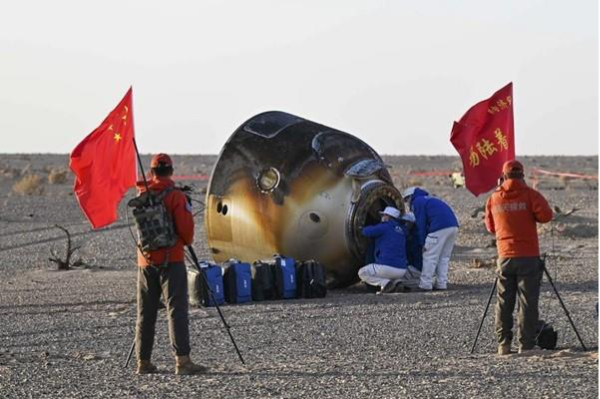
The Shenzhou 21 crew - Zhang Lu, Wu Fei and Zhang Hongzhang - arrived on the station on 31 October to replace the Shenzhou 20 crew, who were due to depart on the Shenzhou 20 craft. However, they were forced to use the Shenzhou 21 craft to safely return to Earth after a crack on the porthole window of the Shenzhou 20 craft was discovered.
The Shenzhou 20 crew landed safely on 14 November at 0840 GMT in Inner Mongolia. Chen Dong broke the record for the total number of days accrued in space (418 days) by a Chinese astronaut (‘Taikonaut’) and for the number of spacewalks (six).
However, this left the Shenzhou 21 crew on the station without a ‘lifeboat’ spacecraft/capsule to return to Earth. Fortunately, the situation only lasted ten days, as an uncrewed launch of Shenzhou 22 was immediately ordered to take place as fast as possible with the launch planned for 25 November. It was originally planned to be launched in April next year.
A Long March 2F/G (CZ-2F/G) was launched from Jiuquan, China, carrying the uncrewed Shenzhou 22 spacecraft at 0411 GMT on 25 November. It docked with Tiangong Chinese Space Station (forward port) at 0750 GMT on same day, ensuring the hitherto stranded crew of Shenzhou-21 (Shenzhou 20 crew took their craft) had a way to return home safely.
Past incidents of window cracks
Windows of human-carrying spacecraft have been damaged before. The Space Shuttle suffered several cracked panes during its long career. None of these events caused a failure of the Space Shuttle orbiter or their crew to return intact.
However, for the smaller re-entry capsule of Shenzhou, things are different.
The windows of the craft are more likely to be exposed to the plasma flow, making them more vulnerable during re-entry. In Shenzhou’s case, only the outer windowpane is guaranteed to be able to cope with the high re-entry temperatures. It was this outer pane that was cracked. Although the inner panes (used to maintain pressurisation) were not cracked, the re-entry was deemed too risky with the damage to the outer pane.
Experience the power of Slingshot’s integrated platform — bringing together real-time orbital data, advanced analytics, AI-powered tools, and developer-friendly APIs.

The #1 Source for Space Data & AI Insights


.png)

.png)