
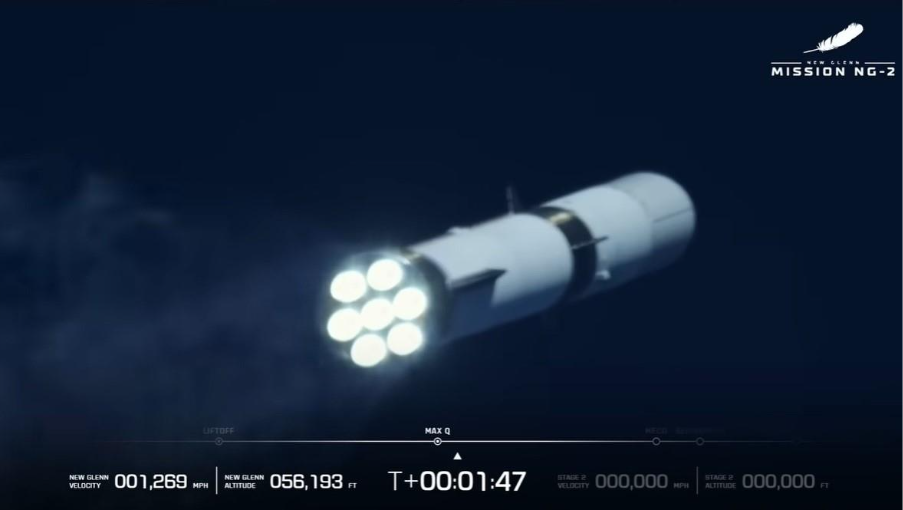
The second launch of the New Glenn rocket (NG-2) took place at 2055 GMT on 13 November from Cape Canaveral, Florida in the US.
The main objective of the rocket was to set a pair of spacecraft, ESCAPADE Blue and ESCAPADE Gold, on their way to orbit the planet Mars. The Escape and Plasma Acceleration and Dynamics Explorers (ESCAPADE) mission is to examine how space weather interacts with Mars (the planet has only a dormant magnetic field).
The launch trajectory put the spacecraft into an elongated transfer orbit with a 100,000 km apogee. The ESCAPADE spacecraft will use their own on-board thrusters to achieve a temporary parking position at the Lagrange L2 point on the Sun-Earth line. This will allow the spacecraft to wait until Mars is in the correct alignment to fully transfer themselves there.
In addition to its main spacecraft payloads, NG-2’s upper stage also carried an attached communications test payload for Viasat.
A secondary aim of the launch was to complete a landing of the reusable first stage. This part of the flight was called ‘Never Tell Me The Odds’. After shutting down its seven main Methane/Lox burning BE-4 engines, the GS1-SN002 stage used a single engine to land downrange on a drone landing ship named Jacklyn. The landing used a hover and reversing approach. This is a more conservative method compared to the one SpaceX uses. For its landings, SpaceX flies in - much like a dive bomber - and fires its braking engines only at the last possible moment. This is a fuel efficient, but riskier, approach.
Blue Origin hopes to gradually reduce the length of its hover in future missions to save propellants. Nonetheless, it was an improvement on the performance of its predecessor, New Glenn flight NG-1, which failed to achieve the feat due an engine that failed to reignite to slow the landing.
See the landing here: https://x.com/i/status/1989358416532488406
Solar storm affected launches
The launch of the ESCAPADE spacecraft, built by Rocket Lab, was delayed from 9 November due to poor weather at the site. There had also been a minor technical issue to ground support equipment.
Perhaps aptly, given the ESCAPADE space weather mission, the launch was then scrubbed for one day on 12 November due to highly elevated solar activity (G4 Severe) and its potential effects on the ESCAPADE spacecraft.
While weather delays to launches are commonplace, space weather delays are not. The Slingshot Seradata launch and spacecraft database records only five such incidents prior to this latest delay.
Post Script:
Who said solar storms only affect spacecraft? Solar radiation was found to corrupt software using 'bit flips' on the control systems of an Airbus A320 aircraft. A mass software modification had to be ordered for 6,000 passenger jets to rectify the problem. This was after Jet Blue A320 went into an unintended nosedive after such an occurrence.
Experience the power of Slingshot’s integrated platform — bringing together real-time orbital data, advanced analytics, AI-powered tools, and developer-friendly APIs.

The #1 Source for Space Data & AI Insights


.png)

.png)