
European countries are not the only ones scrabbling to come up with domestic alternatives to flagship launch vehicles from the US like the Falcon 9 and Starship by SpaceX, and New Glenn by Blue Origin. China, too, is seeking out its own path. However, its first attempt at an orbit-capable operational part-reusable launch vehicle yielded mixed results.
A two-stage Zhuque-3 (ZQ-3) rocket took off satisfactorily at 0402 GMT on 3 December from Jiuquan Satellite Launch Center in China and achieved its primary aim of delivering a test payload into orbit. However, its secondary aim - to land the reusable first stage back on Earth - failed.
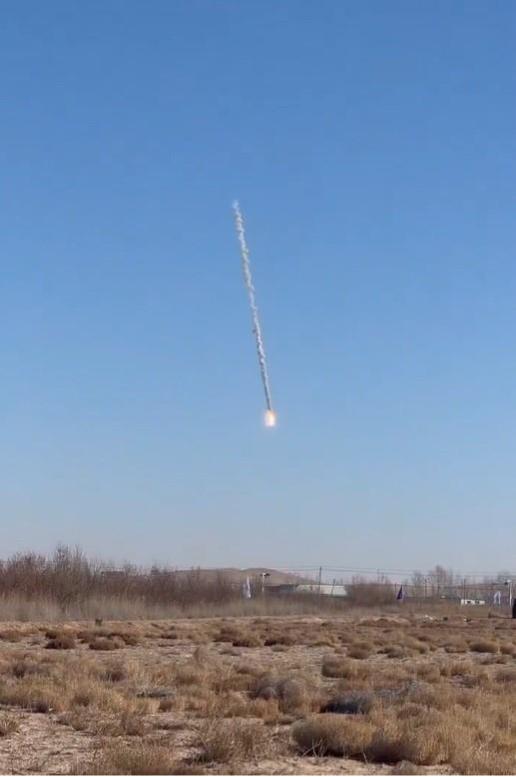
There were no operational payloads on board: just an instrumented dummy carried into orbit for Landspace, the rocket’s commercial owner and operator. Getting a payload to the correct orbit normally defines the success or failure of such a launch – thus this flight was classified as a ‘success’ by Seradata. The flight’s secondary objective (to land its reusable first stage onto land 390 km down range) was also almost achieved. However, a few seconds before landing, the stage was seen to ignite and then spew out black smoke as it rapidly descended back to Earth and crashed.
Investigators are now working on the theory that an engine, or even the structure itself, somehow gave out. This was the second such landing attempt for Zhuque-3. The first also ended in a landing failure, although that was due to a premature shutdown. A full investigation into this latest failure is now underway.
Experience the power of Slingshot’s integrated platform — bringing together real-time orbital data, advanced analytics, AI-powered tools, and developer-friendly APIs.

The #1 Source for Space Data & AI Insights


.png)

.png)